In UV-curable formulation systems, performance often begins long before the material reaches the coating line, lab bench, printer, mold, or production floor. It begins with raw material consistency.
Over the past several weeks, our team has been studying several UV formulation material systems together with upstream technical partners and formulation-oriented suppliers. One point has become increasingly clear:
In UV-curable systems, even small variations in raw material quality can affect formulation behavior.
For applications involving coatings, inks, adhesives, composites, and advanced polymer systems, batch-to-batch variance is not just a quality-control detail. It can directly influence curing performance, viscosity stability, color development, storage behavior, and reproducibility.
Why UV-Curable Systems Are Sensitive to Material Variation
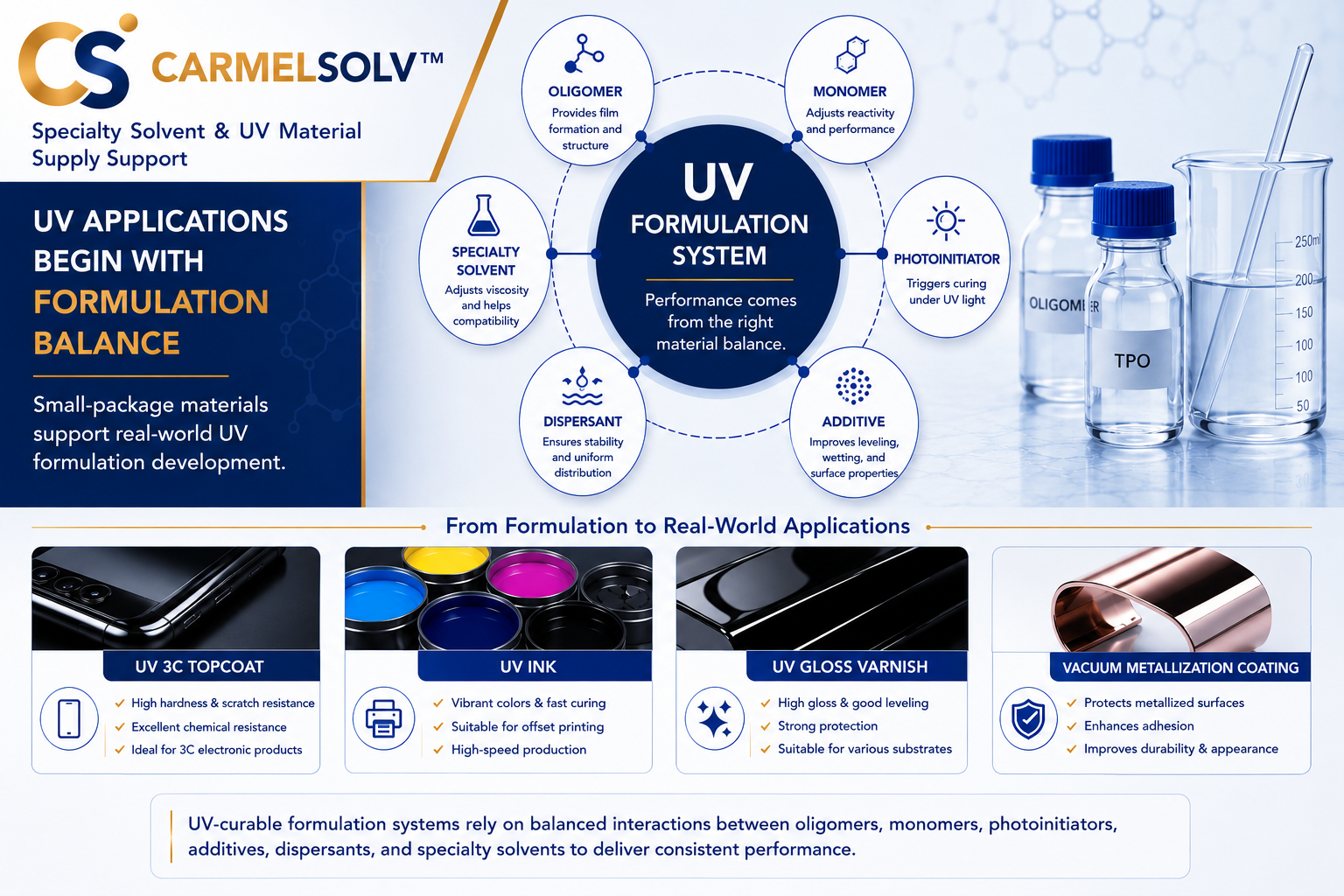
UV-curable formulations depend on a carefully balanced relationship between reactive components, photoinitiators, additives, and process conditions.
A small shift in one material can affect the entire system.
Depending on the formulation, raw material variation may influence:
- Curing behavior
- Viscosity stability
- Yellowing resistance
- Moisture sensitivity
- Storage stability
- Adhesion performance
- Surface cure and through-cure balance
- Overall formulation reproducibility
This is why batch consistency matters. A formulation that performs well in one trial may behave differently if the next material lot has a different impurity profile, water content, acidity level, inhibitor balance, color value, or viscosity range.
For formulators, this can create unnecessary uncertainty. When performance changes, the question becomes difficult to answer:
Is the issue caused by the formulation design, the process conditions, or the raw material batch?
UV Material Categories Under Review
At CarmelSolv, we are currently evaluating multiple UV-related material categories as part of our broader specialty materials development work.
These include selected:
- Reactive diluents
- Specialty monomers
- Oligomer systems
- Photoinitiators
Several materials currently under technical review include:
- HDDA
- TPGDA
- TMPTA
- IBOA
- HEA
- HPMA
- UV oligomer systems
These materials play different roles in UV-curable systems. Some may affect viscosity and reactivity. Others may influence hardness, flexibility, adhesion, cure speed, shrinkage, yellowing behavior, or compatibility with other formulation components.
Because of this, supplier selection and material verification cannot be treated as an afterthought.
Formulation Reliability Starts with Supplier Qualification
Rather than focusing only on formulation recommendations, we believe long-term formulation reliability begins with structured supplier qualification and material verification principles.
For UV-curable systems, a technically responsible supply model should consider more than availability and price.
It should also consider:
- Batch consistency
- Technical documentation
- Traceability
- Regulatory awareness
- Formulation-oriented quality expectations
- Long-term sourcing reliability
- Communication speed when technical questions arise
- Ability to support both sample-scale and production-scale needs
These factors become especially important when customers are working through R&D screening, pilot trials, customer qualification, or production scale-up.
A material may look acceptable on paper, but without consistent documentation, traceability, and supplier discipline, it can become difficult to build confidence over time.
CarmelSolv Supplier Qualification & Quality Assurance Framework
As part of our internal CarmelSolv Supplier Qualification & Quality Assurance Framework — Document Reference: CS-SQS-2026 — we are placing increasing emphasis on structured supplier evaluation and material verification.
Our goal is to better align sourcing decisions with the expectations of formulation teams, laboratory users, technical buyers, and small-to-midscale manufacturers who need reliable material support.
This includes reviewing supplier capabilities around:
- Lot-to-lot consistency
- Product documentation
- Technical responsiveness
- Production and quality controls
- Packaging flexibility
- Regional logistics compatibility
- Long-term supply reliability
For UV-curable systems, this type of framework is especially important because formulation performance can be sensitive to subtle material changes.
Bridging Global Manufacturing and Local Formulation Needs
Many UV-related materials are produced through global manufacturing networks. At the same time, many formulation milestones happen locally and at smaller scale.
Laboratories, pilot teams, formulators, and technical product developers often need practical quantities for:
- Screening studies
- Compatibility testing
- Prototype development
- Customer evaluation
- Small-batch modification
- Internal qualification
- Process validation
This creates a supply gap.
Large-volume manufacturing may be global, but early-stage formulation work often requires localized, flexible, and responsive support.
By aligning structured supplier expectations with our developing small-package supply network and NY/NJ-area logistics, CarmelSolv aims to help bridge the gap between global manufacturing precision and flexible laboratory-scale development needs.
Why This Matters for Formulators
For formulation teams, consistency is not just a purchasing concern. It is part of technical risk management.
When raw materials vary too much, teams may spend unnecessary time troubleshooting problems that are not caused by the formulation itself. This can slow development, complicate customer approvals, and weaken confidence during scale-up.
A more reliable material supply model can help support:
- More repeatable testing
- Cleaner troubleshooting
- Faster qualification cycles
- More stable prototype development
- Better communication between suppliers and formulators
- Stronger confidence during scale-up
In UV-curable systems, batch-to-batch consistency is not a small detail. It is part of the foundation for formulation reliability.
Continuing the Technical Conversation
As we continue expanding our UV material sourcing network, we look forward to learning from scientists, formulators, and technical professionals working across advanced UV and polymer systems.
CarmelSolv is still developing this area step by step, but our direction is clear:
We want to support technical buyers and formulation teams with materials that are not only available, but also supported by documentation, traceability, supplier discipline, and responsive regional logistics.
For questions about UV-related materials under review, supplier qualification, small-package availability, or regional supply support, please contact CarmelSolv.
We welcome conversations with formulation scientists, coating specialists, adhesive developers, resin professionals, laboratory teams, and technical buyers working in UV-curable systems.
Technical note: Material suitability depends on formulation design, process conditions, regulatory requirements, substrate, cure system, testing method, and end-use performance requirements. Customers should conduct their own compatibility and performance evaluation before use.
Request a Quote
Tell us what you need and we'll get back to you with pricing, specs, and availability.