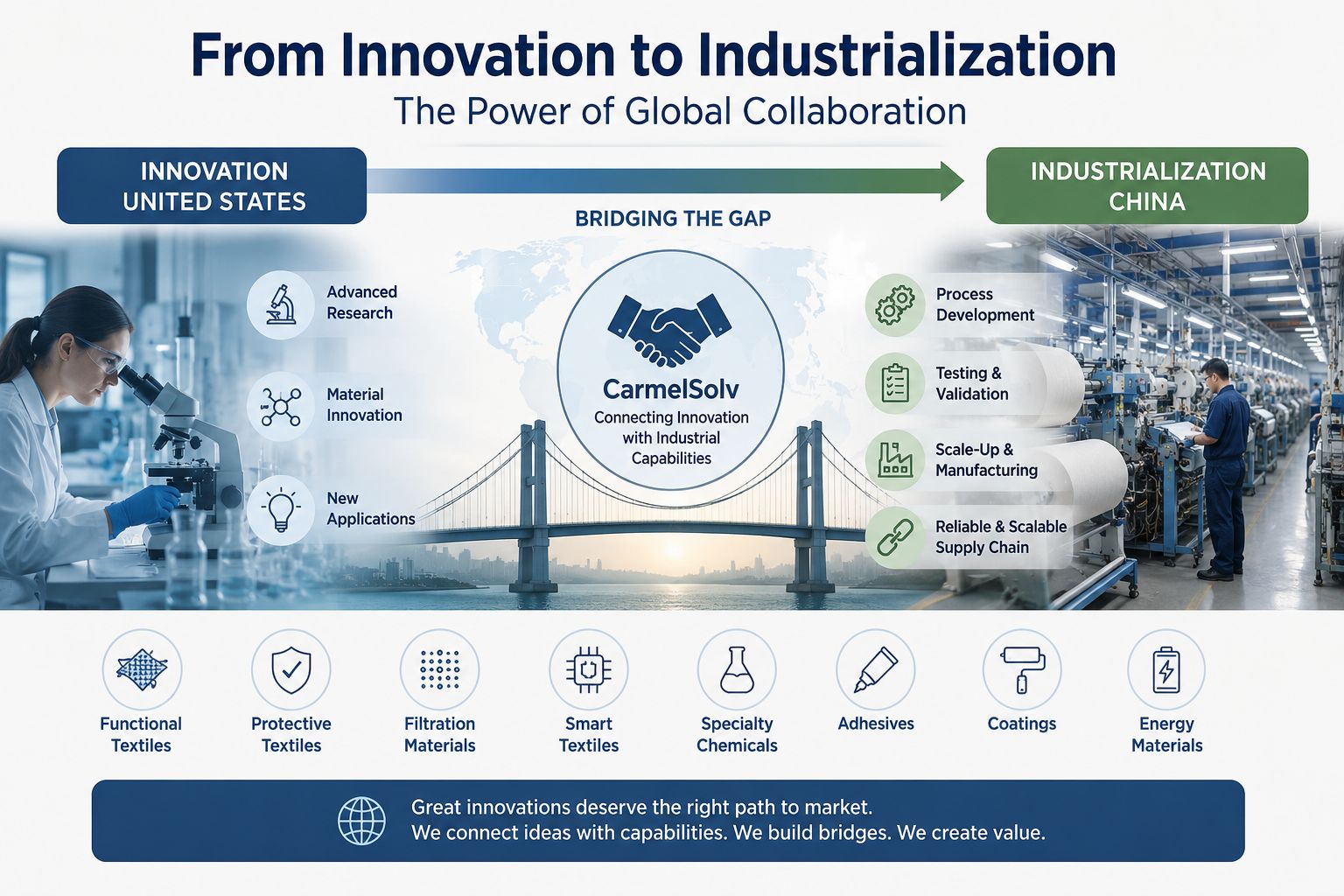
For decades, the United States has been a global leader in textile innovation, functional materials, and advanced research. Many breakthrough technologies begin in universities, research institutions, and corporate R&D centers.
But innovation is only the first step.
Bringing a new textile technology from the laboratory to the market requires material selection, process development, testing, pilot production, performance validation, and scalable manufacturing.
Why Industrial Capability Decides Success
This is where industrial capability becomes critical.
In areas such as performance sportswear, protective textiles, filtration materials, functional coatings, and emerging smart textiles, commercial success depends not only on the strength of the original concept. It also depends on whether that concept can be validated, reproduced, optimized, and manufactured efficiently at scale.
As projects move beyond laboratory testing, access to pilot-scale production, application engineering, testing infrastructure, process optimization, and manufacturing resources often becomes the deciding factor.
The Role of Global Supply Chain Collaboration
This helps explain why many textile innovation programs eventually require collaboration with mature global supply chain ecosystems, including China's industrial manufacturing base.
Over several decades, China has developed one of the world's most comprehensive textile and specialty material manufacturing ecosystems. This ecosystem includes experienced engineers, upstream raw material networks, application testing capabilities, pilot-production resources, and large-scale manufacturing infrastructure.
For innovation teams, this provides access not only to materials, but also to development, validation, and commercialization resources that can help accelerate the path to market.
In many international projects, China's role now extends beyond basic manufacturing. Increasingly, qualified Chinese partners participate in process development, material adaptation, performance validation, cost optimization, and industrial scale-up.
Beyond Textiles
This trend is not limited to textiles.
Across specialty chemicals, functional materials, adhesives, coatings, UV-curable systems, filtration media, and energy-related technologies, scientific innovation often begins in the laboratory, while commercial success depends on effective industrial collaboration.
The greatest value is created not by innovation alone, but by the efficient connection between research, materials, engineering, manufacturing, and market execution.
Bridging Innovation and Industrialization
At CarmelSolv, we focus on helping bridge that gap by connecting innovators with qualified manufacturing, technical, testing, and scale-up resources. Our goal is to support a more efficient pathway from concept validation to industrial implementation.
Great innovations deserve the right path to market.
What functional materials or textile technologies do you believe will have the greatest impact over the next decade?
Request a Quote
Tell us what you need and we'll get back to you with pricing, specs, and availability.