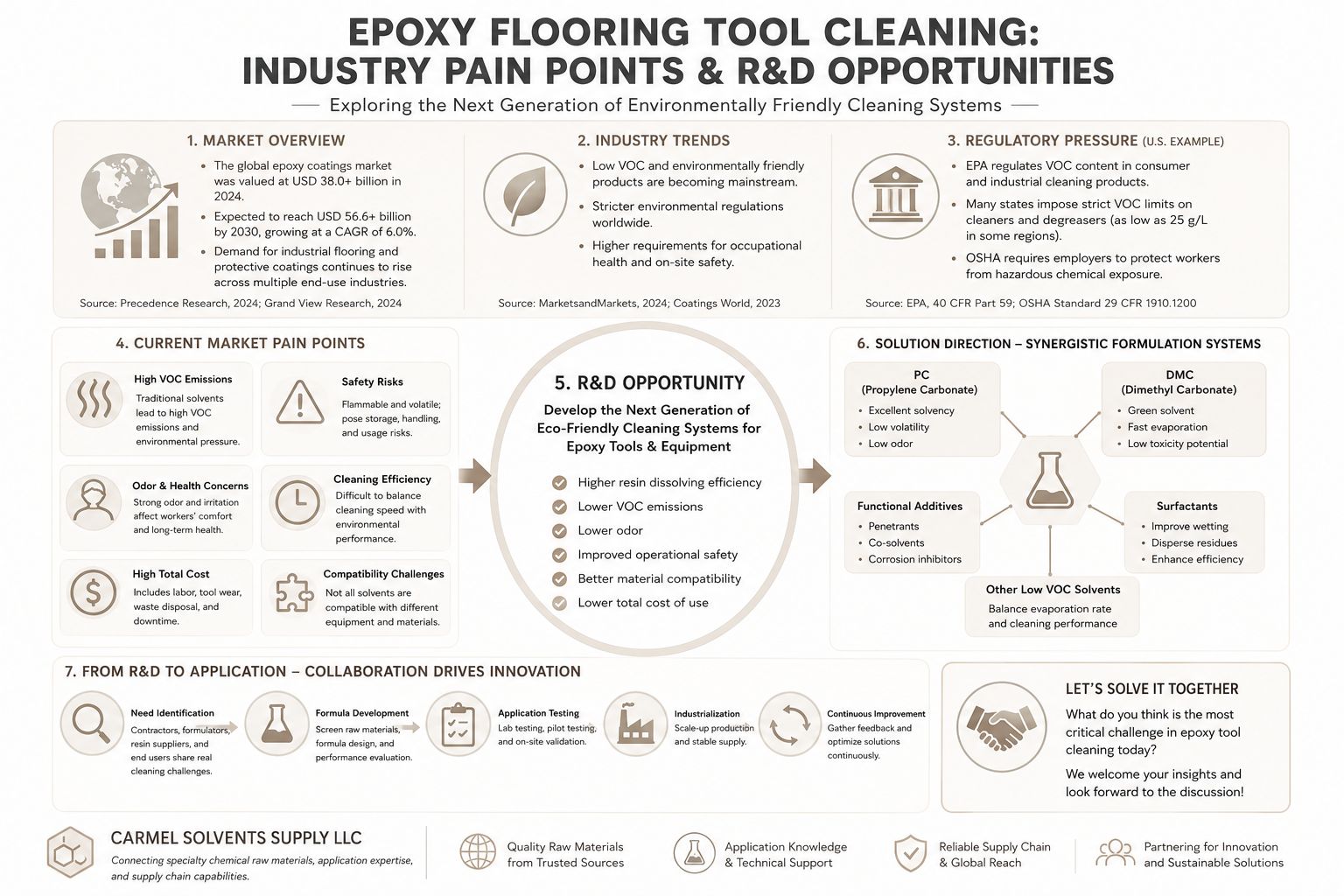
Industrial epoxy systems continue to evolve, with growing demand for higher performance, lower VOC emissions, and safer jobsite practices.
However, one important challenge is often overlooked:
Epoxy construction tool and equipment cleaning.
Before epoxy resins cure, rollers, spray guns, mixers, scrapers, and other application tools must be cleaned thoroughly. If cleaning is inefficient, contractors may face longer labor time, higher tool replacement costs, increased solvent consumption, and more hazardous waste management challenges.
The Pain Points of Traditional Cleaning Solvents
Traditional solvents such as acetone, MEK, and aromatic solvent systems are still widely used in many epoxy cleaning applications. While they can be effective, they also create several practical and regulatory challenges.
Key pain points include:
- VOC and regulatory pressure
Increasingly strict VOC requirements are pushing the industry toward lower-emission cleaning systems. - Flammability and handling risks
Many traditional solvents require careful storage, transport, and jobsite handling due to flammability concerns. - Odor and occupational health concerns
Strong solvent odors can affect worker comfort and raise health and safety concerns on active jobsites. - Cleaning efficiency limitations
Contractors need cleaning systems that work quickly before resin begins to cure, while also remaining compatible with tools, equipment, and surfaces. - Total cost of ownership
The real cost of tool cleaning includes labor, solvent usage, tool wear, downtime, disposal cost, and compliance management.
Is the Next Generation of Solvent Systems the Answer?
The future of epoxy tool cleaning is unlikely to depend on one single “miracle solvent.”
A more realistic direction is the development of balanced formulation systems that combine solvent performance, lower VOC direction, material compatibility, and operational safety.
Potential formulation components may include:
Propylene Carbonate (PC)
Propylene Carbonate offers strong solvency, low volatility, and low odor. It may be useful in systems where slower evaporation and improved resin interaction are required.
Dimethyl Carbonate (DMC)
Dimethyl Carbonate is often discussed as a greener solvent option due to its favorable environmental profile compared with many traditional solvent systems. However, formulation design must still account for flammability, evaporation rate, compatibility, and jobsite handling requirements.
Functional Additives
Penetrants, co-solvents, surfactants, and corrosion inhibitors may help improve wetting, resin removal, residue dispersion, and overall cleaning efficiency.
The strongest opportunity is not simply replacing one solvent with another. It is developing a synergistic cleaning system that balances:
- Resin-dissolving efficiency
- VOC and regulatory considerations
- Odor reduction
- Worker safety
- Tool and equipment compatibility
- Waste disposal management
- Total cost of ownership
From R&D to Application
Developing next-generation epoxy tool cleaning systems requires close collaboration between contractors, formulators, resin suppliers, raw material suppliers, and end users.
A practical development pathway may include:
- Identifying real jobsite cleaning challenges
- Screening solvent and additive combinations
- Testing cleaning efficiency against uncured epoxy systems
- Evaluating odor, evaporation rate, material compatibility, and residue behavior
- Conducting pilot testing under realistic jobsite conditions
- Optimizing the formulation for cost, safety, and performance
This type of application-driven R&D can help bridge the gap between laboratory formulation and real-world construction use.
Discussion
For epoxy flooring, industrial coating, and construction professionals:
What is your biggest challenge when it comes to tool and equipment cleaning?
- Cleaning efficiency
- VOC and regulatory restrictions
- Odor and occupational health concerns
- Flammability and safety
- Total cost control
- Waste disposal cost
- Tool compatibility
Technical feedback from the field is essential for developing better cleaning systems.
At Carmel Solvents Supply LLC, we are interested in supporting discussions around specialty raw materials, formulation development, and more sustainable cleaning solutions for industrial applications.
Request a Quote
Tell us what you need and we'll get back to you with pricing, specs, and availability.