Today's formulators are under increasing pressure to balance performance, sustainability, cost efficiency, and regulatory compliance.
Whether the application is personal care, home care, industrial cleaning, coatings, adhesives, or textile processing, raw material selection often determines the success of the final formulation.
Among the most important building blocks are oleochemicals and surfactants.
These materials are far more than simple ingredients. They directly influence cleaning efficiency, foam performance, emulsification behavior, viscosity control, surface modification, product stability, and sustainability performance.
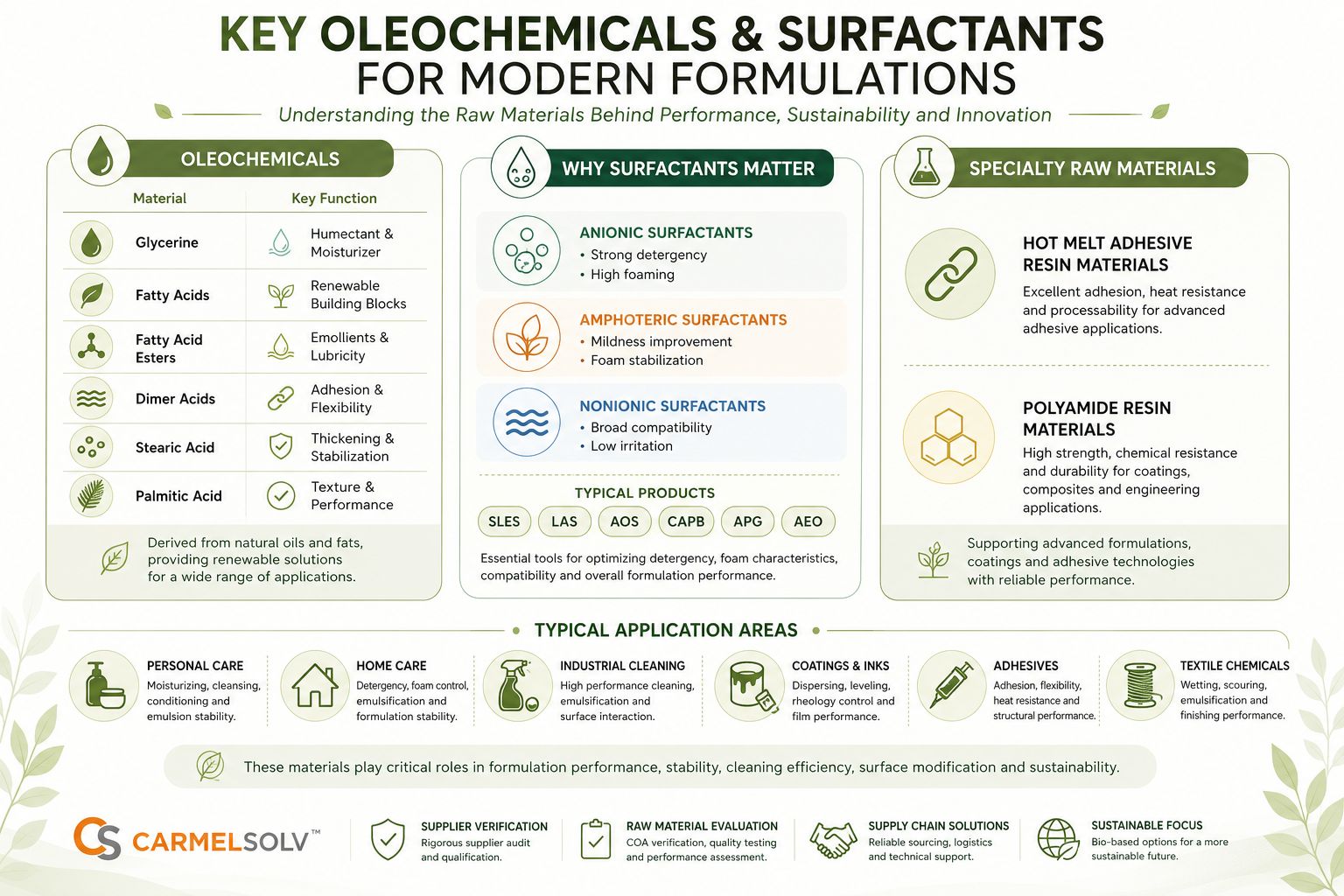
Oleochemicals: Renewable Building Blocks for Formulation Performance
Oleochemicals are commonly derived from natural oils and fats and are widely used across personal care, home care, industrial, and specialty chemical applications.
Key examples include:
Glycerine
Glycerine is widely used as a humectant and moisturizer in personal care and related formulations. It helps support moisture retention, texture, and product feel.
Fatty Acids and Fatty Acid Esters
Fatty acids and fatty acid esters serve as renewable feedstocks for a broad range of specialty chemical applications. They are commonly used to support emolliency, lubrication, compatibility, and formulation structure.
Dimer Acids
Dimer acids are important raw materials for adhesives, coatings, and resin systems where flexibility, adhesion, and durability are critical.
Stearic Acid and Palmitic Acid
Stearic acid and palmitic acid are commonly used in formulations where thickening, stabilization, texture, and performance control are required.
Why Surfactants Matter
Surfactants play a central role in many modern formulations. They help control detergency, foam behavior, emulsification, wetting, dispersion, and compatibility between different formulation components.
Common surfactant categories include:
Anionic Surfactants
Anionic surfactants are often selected for strong detergency and high foaming performance.
Amphoteric Surfactants
Amphoteric surfactants can support mildness improvement, foam stabilization, and compatibility in selected systems.
Nonionic Surfactants
Nonionic surfactants are valued for broad compatibility, low irritation potential in selected applications, and formulation flexibility.
Typical surfactants include SLES, LAS, AOS, CAPB, APG, and AEO, which are widely used to optimize detergency, foam characteristics, compatibility, and overall formulation performance.
Specialty Raw Materials for Advanced Applications
Beyond oleochemicals and surfactants, specialty raw materials also play important roles in modern formulation systems.
Hot Melt Adhesive Resin Materials
These materials support adhesion, heat resistance, processability, and performance in advanced adhesive applications.
Polyamide Resin Materials
Polyamide resin materials are used in applications requiring strength, chemical resistance, durability, and compatibility with coatings, composites, and engineering systems.
Together, these materials support advanced formulations, coatings, adhesives, and specialty chemical technologies with more reliable performance.
Typical Application Areas
Oleochemicals, surfactants, and specialty raw materials are used across a wide range of industries, including:
- Personal care
- Home care
- Industrial cleaning
- Coatings and inks
- Adhesives
- Textile chemicals
- Specialty formulations
- Surface modification systems
As sustainability continues to drive innovation across industries, bio-based and oleochemical-derived materials are receiving growing attention as practical options for many formulation platforms.
CarmelSolv Raw Material Evaluation
Understanding these materials, and selecting reliable supply partners, can significantly improve development efficiency, formulation performance, and long-term product consistency.
At CarmelSolv, we continue to evaluate and monitor a broad range of oleochemicals, surfactants, and specialty raw materials through supplier verification and raw material assessment programs.
Our focus includes:
- Supplier verification
- COA review
- Quality parameter evaluation
- Batch-to-batch consistency
- Raw material traceability
- Supply chain reliability
- Application-focused material assessment
Our goal is to help customers source materials that support performance, consistency, and long-term formulation success.
Samples and Documentation
COAs and samples for selected materials are available upon request.
For more information about oleochemicals, surfactants, or specialty raw materials, please contact CarmelSolv.
Request a Quote
Tell us what you need and we'll get back to you with pricing, specs, and availability.